TL;DR
- As you navigate the SaaS industry, the need for SaaS billing becomes apparent.
- SaaS billing involves intricate tasks beyond invoicing, such as customer relationship management and revenue tracking, which are crucial for your business's success.
- Challenges and complexities of SaaS billing such as aligning billing with business models, managing subscriber bases, and handling multi-currency transactions emphasize the need for a robust solution.
- Learn about the three fundamental billing models—subscription, usage-based, and hybrid—and how they can be tailored to your customers' needs.
- If your team is bogged down by spreadsheets or you're looking to minimize churn, it's time to invest in a SaaS billing platform.
- The top 6 features to look for in SaaS billing software include complete automation, payment gateways, flexible plans, seamless integration, robust analytics, and convenient portals.
- With insights on selecting the right software and best practices for SaaS billing, you're equipped to enhance your billing operations, improve customer satisfaction, and secure a predictable revenue stream for sustained growth.
Transforming Businesses with SaaS Billing: A Comprehensive Guide
In the fast-paced world of Software-as-a-Service (SaaS), technology isn't just propelling growth—it's also stoking competition. As a significant player in this arena, you're likely well-acquainted with the ins and outs of steering through the landscape of subscription and usage-based services.
It's a world where juggling customer relationships, monitoring activations, managing upgrades and downgrades, handling billing cycles, and keeping tabs on accounts receivables can pose quite the challenge.
That's precisely where a solid grasp of 'SaaS Billing' steps in as an essential asset. The goal of this article is to provide you with an in-depth comprehension of SaaS Billing while underscoring the substantial worth that billing software can deliver to your business. So, stick around as we dive into these facets with a keen eye.
Understanding the SaaS Billing System
For SaaS companies, billing stretches far beyond the simple act of dispatching invoices. It encompasses a web of tasks that includes nurturing customer relationships, monitoring activations, handling upgrades and downgrades, overseeing billing cycles, and managing accounts receivables. To kick things off, let's delve into the essence of SaaS billing.
What is SaaS Billing, and How Does it Function?
SaaS billing is a distinct breed of billing methodology, finely tuned to suit the dynamics of subscription and usage-based software services. It's a comprehensive journey that spans various undertakings, extending from the basics of invoicing and payments all the way to the intricate realms of collections and responsive customer support. This isn't your run-of-the-mill invoicing system. It operates with a bespoke suite of features and functionalities tailored to its unique demands.
So, how does SaaS billing function? Here's a step-by-step rundown:
- Begin with creating master data that includes involved parties and amounts, stored securely online or offline.
- Send invoices for subscribed software services, ensuring transparent communication about products or services.
- Automate invoice generation, timely reminders, and collections, fostering error reduction and client trust.
- Provide dedicated support for billing and subscription inquiries, nurturing positive customer relationships.
- Ensure adherence to guidelines with technology that secures transactions through encryption and anti-fraud measures.
- Track payments, reconcile, and manage revenue, streamlining intricate revenue tracking tasks.
Efficiency in SaaS billing hinges on adaptable pricing models that accommodate diverse customer requirements while automating tasks and refining operational efficiency.
3 Fundamental SaaS Billing Models
SaaS companies have three primary models at their disposal:
- Subscription-Based Billing: Customers pay a regular fee (monthly/annually) for access to the software service, much like subscribing to Netflix or Spotify Premium.
- Usage-Based Billing: This flexible model charges according to actual usage, offering user-friendly dashboards to track consumption patterns.
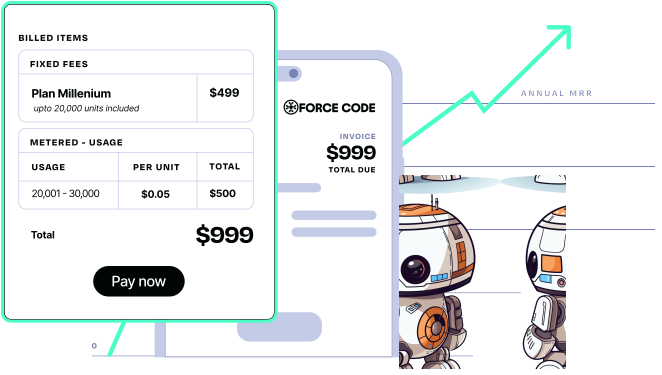
- Hybrid Models: These blend subscription-based charges with usage fees for extra services beyond a set limit. Think of mobile phone plans with monthly fees plus additional costs for data or international calls.
SaaS Billing Software: What is it All About?
Billing processes are an indispensable component of any organization. However, SaaS companies confront unique challenges that aren’t common in other business verticals. Billing operations for SaaS companies encompass an array of tasks like:
- Invoicing
- Payments
- Billing collections
- Customer support
All these aspects go into making an efficient and successful billing process.
Adopting a SaaS billing software is the most pragmatic and sensible move for SaaS businesses struggling to streamline the billing process. Such billing platforms have the latest tools and technologies to manage complex business scenarios.
Click here to gain more insights about SaaS billing software. Our blog “SaaS Billing Software: a Complete Guide” has it all.
What Necessitates the Need For a SaaS Billing Platform for Your Business
Your business may require a SaaS billing software if:
Your team depends on spreadsheets to manage your billing.
It’s almost impossible to manage SaaS billing with spreadsheets, especially if you want to get your company up and running from the initial stages. You do not have to wait until your company has matured enough to invest in billing software. Start early to see the difference it makes!
You want to reduce customer churn.
SaaS billing software gives you in-depth insights into metrics like Monthly Recurring Revenue (MRR), subscriber lifetime value, and customer churn rates. With these details at your disposal, you can effectively curb churn, identify business opportunities, and monitor your financial health.
You want to modify your billing approach to suit your customers' needs.
Tired of handling being unable to seamlessly implement subscription-based pricing to sell your SaaS products or services? Frustrated about handling only specific billing models? An advanced billing solution will help you overcome these challenges and align your process as per your customer requirements.
So, when you decide to invest in a SaaS billing software, you will encounter a plethora of choices, with each choice packed with multiple features. Given below are must-have features that will make your software a worthwhile, long-term investment.
Also read: Crucial Distinctions: Bookings, Billings & Revenue in B2B SaaS Explained
Top 6 Features to Look For in SaaS Billing Software
1. Complete automation
Look for a billing solution that automates the following tasks:
- Invoice generation
- Payment processing
- Usage tracking
Automating these tasks significantly reduces the chances of errors and wastage of resources, leading to better process efficiency and customer satisfaction.
2. Payment gateways
Payment gateway integration is a fundamental aspect of most online businesses. While having a payment processing feature is convenient, customers value other features like:
- Secure portals.
- Fee transparency without any hidden charges
- Easy transactions in any currency.
- Low-fee processing options
3. Flexible plans
Organizations can help customers manage their bills and cash flow by offering flexible payment plans like annual and monthly subscriptions. This flexibility allows customers to choose payment options that suit them best.
4. Seamless integration
Your billing software can only be enhanced when it seamlessly integrates with your other technological capabilities, such as:
- CRM and ERP software
- Taxation software
- Business-specific platforms
Native or API-based tech stack integration enables more accurate data, faster internal processes, improved payment failure recovery, and more.
5. Robust analytics
Does your billing software come with sophisticated analytical tools capable of generating in-depth reports? Check if the platform gives you insights about your:
- Sales- To identify buying patterns and forecast future trends.
- Marketing- To understand product usage and customer preferences.
- Customers- To identify churn risks.
6. Convenient portals
Self-service portals are customer-friendly features that enable easy management of accounts and subscriptions. With these portals, customers can easily access their information, update their account details, and make online payments.
Moreover, this feature benefits your organization by saving time and money while enhancing your customer service capabilities.
When analyzing your platform, it’s essential to consider the beneficial features and the challenges it presents. It’s vital to understand the issues you may face while using it.
Challenges and Complexities of SaaS Billing
Some of the SaaS billing intricacies you may have to navigate include:
- Aligning your billing process with your business model because the specifics of your billing process and your billing software may vary.
- Streamlining your subscriber management and keeping it error-free, especially when your subscriber base expands.
- Supporting multi-currency transactions through varied payment modes like e-wallet, net banking, credit and debit card payments.
- Setting a flexible billing cycle that allows price flexibility and payment convenience for your subscribers.
- Defining ARR and MRR, especially from month-to-month-based offerings, discounts, usage-based revenue, subscription revenue, one-time payments, etc.
- Handling cancelation dates, refunds, and account credits to streamline billing workflows and reporting.
- Enabling timely notifications for payment success or failures, promotions, discounts, upgrades, downgrades, and free trials.
- Tracking and remaining updated with the evolving taxation rules, failing which you may incur substantial penalties and losses.
- Accommodating customer’s fluctuating service needs. You may have to add, remove, or temporarily suspend certain services multiple times in a single billing cycle.
Handling SaaS billing may seem a bit tricky. Fortunately, there are robust billing solutions with advanced features to help you smoothen out these creases with minimum effort. It all depends on how well you choose your SaaS billing software.
How to Choose a SaaS Billing System?
The key to selecting an effective SaaS billing system lies in identifying a platform that meets your organization’s specific billing needs while providing adequate security measures. It is not like randomly picking a software and implementing it overnight. Instead, it necessitates a thorough consideration of certain distinct requirements based on the value it provides and your ROI.
Head over to our blog “12 Criteria to Select the Best Billing Solutions For SaaS Businesses” to gain in-depth guidance to choose your SaaS billing software.
SaaS Billing Best Practices to Revamp Your SaaS Billing Game
SaaS billing is more than just invoicing your customers and collecting your payments.
This business model is driven by customer-centricity - an approach that seals your success through your customers’ experience. From a financial perspective, SaaS businesses benefit from a predictable revenue stream that facilitates easier and more accurate financial tracking and forecasting.
However, all this is easier said than done with SaaS billing. Aspects like recurring billing management, revenue recognition, and plan renewal can pose unique challenges hindering your company’s ability to maximize the full revenue potential.
Our blog “ Mastering SaaS Billing: Top 10 Practices” unravels the complexities and puts you on the road to SaaS billing success. Click here to read it.
To Summarize
Comprehending SaaS billing and adopting robust billing software stands as a crucial factor for excelling in the fiercely competitive SaaS market. A top-tier billing solution effortlessly manages customer relationships, activations, upgrades, downgrades, billing cycles, and receivables. Its significance goes beyond accurate invoicing and boosted ROI- it is about streamlining operations and captivating customers.
Furthermore, by leveraging the capabilities of a comprehensive SaaS billing system like Togai, you can seamlessly turn billing challenges into competitive edges.
Curious about the transformation? Try Togai for free today.
As we embrace the rapid digitalization and emerging trends within the SaaS landscape, let's recall the words of Bill Gates: "The advance of technology is based on making it fit in so that you don't really even notice it; it's part of everyday life."
Here's to achieving future growth and success by harnessing the power of efficient billing systems!