TL;DR
- If you're weighing feature-based pricing vs tiered pricing for your SaaS business, it's crucial to understand each model's strengths and limitations.
- Feature-based pricing allows customers to pay for only the features they use, offering a customizable approach that can be ideal for complex products.
- Tiered pricing, on the other hand, offers packages with varying levels of features, support, and storage, which can cater to a broader customer base and provide clear value propositions.
- While tiered pricing is beneficial for both businesses and customers, feature-based pricing might be the better choice for SaaS businesses with complex offerings.
- Togai offers advanced Usage-based Metering and Billing Software that supports any pricing model, helping businesses implement and manage their chosen strategy effectively.
- Your final decision on feature-based pricing vs tiered pricing should be guided by your customers' needs and how they value your offerings, ensuring your pricing model is sustainable in the long term.
Subscription-based businesses require several essential elements to succeed, and one of them is a pricing strategy. It cannot be any random pricing strategy. It has to be a robust and effective one capable of driving business revenue, performance, profitability, and sustainability.
SaaS businesses, in particular, have to be extra cautious in selecting the pricing strategy. You must test it based on your target customers, business model, and competitors.
What if you had to choose between feature-based pricing and tiered pricing?
To simplify your decision-making process, our article compares both pricing strategies to help you choose the best option.
An Introduction to Feature-Based & Tiered Pricing Models
Before comparing pricing models, it is crucial to understand each model's fundamental principles comprehensively.
Feature-Based Pricing
As the name denotes, feature-based pricing charges customers based on the features of a product or service. For SaaS businesses, this model allows customers to access additional features by paying more.
How does feature-based pricing work?
This pricing model individually segregates the features of a service or product and assigns a price value to each set of features. Customers can select a pricing plan that fits their requirements and budget. Hence, they do not have to pay for features they do not use.
For example, customers pay a basic fee when they join a gym. The gym charges extra when the customer decides to enjoy other conveniences like a personal trainer, access to saunas, or to get a customized diet plan.
Similarly, magazine subscriptions charge more to access archived articles, make digital copies, etc.
Tiered-Based Pricing
Tiered pricing or price tiering is a popular SaaS pricing strategy. Companies that adopt tiered pricing offer variously priced packages to customers. Each tier or package differs in terms of user support, storage space, or features depending on how much the customers pay.
A classic example of tiered pricing is Netflix. The popular streaming platform’s pricing tiers are clearly segregated based on video quality and the number of screens users can watch simultaneously.
Here’s a glimpse of how Netflix’s tiered pricing plans work:
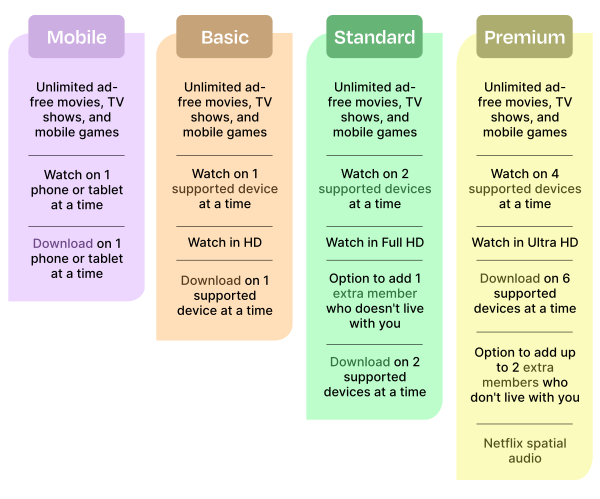
Tiered pricing is a win-win model for businesses and customers. The model enables easy product monetization on the business end and covers a more extensive customer base. On the other hand, buyers get the most value for their money by choosing a tier that best fits their needs.
It now boils down to one question: Which is the better pricing strategy: Feature-based or tiered pricing? The best way to arrive at an answer would be to compare the pros and cons of both pricing models.
Also Read: Tiered Pricing Vs. Volume Pricing: What Would Be The Best Strategy
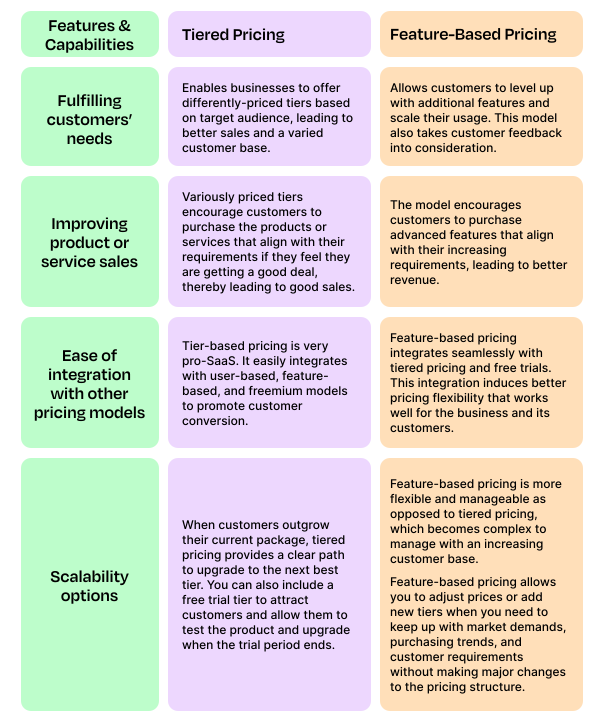
Unveiling the Pros and Cons of Feature-based vs. Tiered Pricing
Pros
Cons
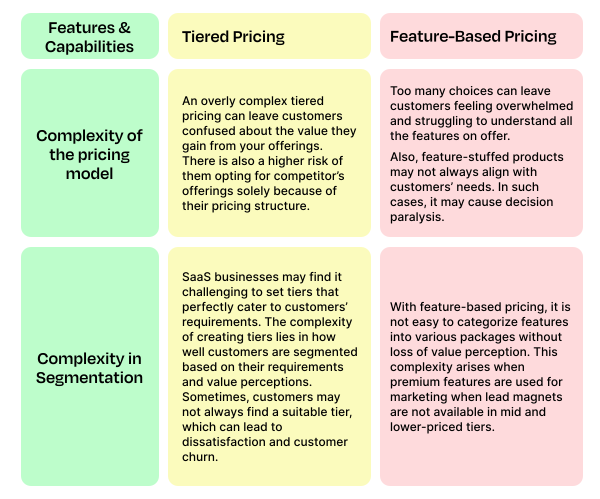
Based on the information provided, it is clear that both options have their own strengths and challenges. The best choice for your business will depend on your specific circumstances.
Tiered or Feature-Based Pricing: Who Wins?
Without any shred of doubt, tiered and feature-based pricing are powerful strategies with the potential to drive sales, increase your customer base, and improve your overall business growth.
Tiered pricing is an amazing model because it benefits everyone. However, for SaaS businesses offering complex products, feature-based pricing might be the better choice because it enables customization based on users’ needs.
Whatever the choice, your decision should be based on your customers’ needs and how they value your offerings. This strategy is crucial in making your pricing model work for the long haul. Your pricing structure should appeal to many customers and incentivize them to choose higher-value options.
Conclusion
Togai is an advanced Usage-based Metering and Billing Software that supports any pricing model with in-depth insights and flexibility. Our platform also helps businesses with pricing model implementation and management to achieve desired results. Contact Togai for expert resources and tools. Schedule a free demo today.