
TL;DR
- If you're in the market for the best SaaS billing software, you'll want to consider the top five contenders that cater to various business needs.
- Investing in billing software is imperative for SaaS businesses to save time and resources.
- Automation, workflow streamlining, secure payment gateways, recurring billing management, and deferred revenue handling are key benefits of billing software.
- Togai stands out for B2B SaaS with its real-time metering and tailored pricing models.
- Stripe is favored by PLG companies for its extensive integrations and usage-based pricing, despite some limitations in analytics.
- Recurly offers personalized billing systems and machine learning to combat churn, but may lack in reporting sophistication.
- Chargebee excels in subscription management and automation, suitable for growing SaaS businesses, though its UI and customization could be improved.
- Chargify targets B2B SaaS with complex billing needs, offering personalized solutions, but at a potentially higher cost.
- Remember to compare features, pricing, customization, integration capabilities, and SaaS reporting when choosing the right billing solution for your business.
- Schedule a free demo with Togai to experience hassle-free billing.
While launching a SaaS business, one pivotal decision stands out among the rest: the choice of a billing system. With a plethora of options available, determining the ideal fit for your venture can pose a challenge. Yet, it's clear that manual methods or unadapted software solutions would waste both time and resources. Hence, investing in billing software emerges as an imperative.
Billing software serves as the linchpin, offering a wide range of benefits:
- Automation: By automating processes, it liberates valuable time, enabling focus on strategic initiatives.
- Workflow Streamlining: It facilitates the seamless flow of operations and adeptly tracks crucial SaaS metrics.
- Secure Payment Gateways: Providing clients with secure payment gateways enhances convenience and fosters trust.
- Recurring Billing Management: Efficient handling of recurring billing ensures consistent revenue streams.
- Deferred Revenue Handling: It adeptly manages deferred revenue, a critical aspect of financial stability.
The significance of SaaS billing software cannot be overstated. However, the challenge lies in pinpointing the solution that aligns perfectly with your business requisites. In this article, we'll delve into the five best SaaS billing software, dissecting their merits and demerits. So, let’s get started.
The 5 Best Billing Software for SaaS Businesses
Togai
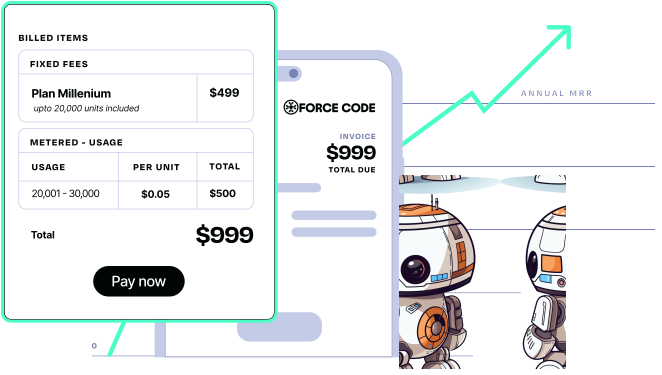
Introducing Togai, the ultimate metering and billing platform designed specifically for B2B SaaS businesses. With Togai, you can effortlessly go live with any pricing model of your choice, streamlining revenue management and allowing you to focus on what truly matters: growth.
Pros:
- Effortless metering: Simplify customer billing and feature management with real-time metering capabilities.
- Tailored pricing models: Pricing models customized to fit any business need, from subscriptions to custom enterprise contracts.
- Seamless payment processing: Generate, customize, and auto-send invoices while effortlessly collecting payments through Togai’s tight payment gateway integrations.
- Versatile growth models: Whether your business operates through self-serve PLG, sales-led enterprise deals, or a combination of both, Togai is equipped to fulfill your needs.
Togai integrates seamlessly with a variety of payment gateways, including PayStack and Stripe, allowing you to customize, auto-send, and generate invoices with ease. Our tight payment gateway integrations ensure that collecting payments is as simple as can be.
But that's not all - Togai isn't just a one-size-fits-all solution. It is one of the best SaaS billing solutions you will ever find. Automate your billing, monitor customer usage, and effortlessly optimize your pricing with Togai, the go-to solution for entrepreneurs and startups looking to take their business to the next level.
Stripe
Stripe stands out as a top-tier SaaS billing system, widely recognized as the go-to choice among PLG (product-led growth) companies. Acting as a multifaceted platform, it serves as a merchant account, payment gateway, and subscription management hub. Additionally, it offers lightweight analytics features coupled with round-the-clock customer service, a crucial advantage in the billing scenario. Leveraging machine learning, Stripe optimizes your billing process efficiently.
Pros:
- Stripe boasts extensive integrations with banks and card networks, complemented by a potent API.
- Its usage-based pricing model simplifies the onboarding process, making it accessible for SaaS startups to adopt swiftly.
- Users consistently commend Stripe's billing for its comprehensive documentation and the robustness of its APIs.
- Stripe adeptly caters to the billing requirements of both small businesses and enterprises on the rise.
Cons:
- While offering analytics features, Stripe's capabilities in this area are limited.
- With the additional services offered by Stripe, pricing may become confusing.
Recurly
Recurly is a platform offering unparalleled personalization to align perfectly with your requirements. Engineered with developers in mind, its API empowers you to craft a billing system tailored to support a range of business models and pricing plans seamlessly. For smooth operation, Recurly necessitates integration with a Merchant account and a payment gateway, typically layered atop services like Braintree or Stripe.
Pros:
- Navigate through intricate billing models effortlessly while accommodating multiple languages, payment methods, and currencies.
- Prevent churn and reclaim subscribers, bolstering your Monthly Recurring Revenue (MRR) through the strategic utilization of machine learning.
- Seamlessly connect with payment gateways, various financial tools, and CRM systems, enhancing operational efficiency.
- Enjoy comprehensive subscription management capabilities coupled with enhanced flexibility for different billing models.
Cons:
- Recurly's reporting capabilities may not match the sophistication of standalone SaaS analytics tools.
- Recurly may not offer the level of customization desired by some users.
Chargebee
Chargebee is a subscription management system tailored specifically for recurring billing and SaaS subscription needs. Much like Recurly, Chargebee doesn't serve as a payment gateway or merchant account provider, requiring integration with another service. However, its commitment to the SaaS sector shines through continuous feature launches, ensuring relevance to your evolving business landscape. Chargebee's platform facilitates seamless automation of all online payments and billing tasks, with integration capabilities extending to 30 payment gateways, CRM systems, accounting software, and even Upflow!
Pros:
- Reduce churn rates and boost revenue through upselling, discounting, and cross-selling strategies, ultimately leading to higher Monthly Recurring Revenue (MRR).
- Manage high data volumes while enjoying greater flexibility in billing workflows.
- Ensures smooth transitions as your business grows from an SMB to a bigger SaaS business.
- With a simple invoicing structure, Chargebee caters effectively to companies with recurring payment models and traditional subscriptions.
Cons:
- Chargebee's user interface does not offer a visually appealing experience.
- Users may find Chargebee's software less customizable, restricting the ability to add new features or make significant changes.
Chargify
Chargify is a subscription billing software tailored specifically for B2B SaaS companies. Chargify caters directly to this niche of recurring revenue businesses, offering personalized solutions down to segmented pricing and one-to-one billing workflows. Chargify does not provide a merchant account or payment gateway. Hence, its tools should be integrated with other services.
Pros:
- Drive retention rates higher with add-ons and features such as dunning prevention tools and targeted promotions.
- Engage customers throughout their lifecycle with personalized notifications tailored to each stage.
- Offers support for complex billing scenarios. This makes Chargify suitable for any SaaS business, regardless of its pricing structure.
- Chargify shines particularly for companies with intricate billing plans.
Cons:
- Chargify's pricing may be expensive for smaller SaaS companies with limited budgets.
- Users may find the customization options for invoices lacking compared to other platforms.
Also Read: Navigating Telecom Billing Challenges with Effective Solutions
Top Things to Consider While Choosing a Billing Platform for SaaS
Switching software can be daunting, but staying with the same SaaS platform might limit your growth potential. It's crucial to assess the right time to add a new tool to your finance stack to foster growth effectively. While basic subscription billing automation is offered by all SaaS billing platforms, selecting the right one involves more advanced considerations. Here's what you need to keep in mind when choosing the perfect billing software for your SaaS business:
- Compare Features & Pricing
Look into features and pricing structures. Some platforms charge a flat percentage fee per transaction, while others opt for a monthly or yearly fee. Consider your turnover when making this decision.
- Check Customization
Assess the level of customization offered by each SaaS billing tool, especially if you have a complex product and billing structure. A highly customizable system will help streamline automation.
- Integration Abilities
Integration capability via API is crucial for your billing software. It enables real-time centralized data management, fostering future growth flexibility. Choose a billing solution that seamlessly integrates with your existing tech stack.
- SaaS Reporting
Many billing software options lack a comprehensive understanding of Monthly Recurring Revenue (MRR). Ensure that your chosen platform allows for detailed analysis of recurring revenue data.
- Add-ons vs. Included
Evaluate the various bundled modules for payment processing, billing, accounting automation, and subscription management to find a solution that fits your needs and budget.
Effective subscription management through robust SaaS billing solutions is vital for any SaaS business. Therefore, it's worth taking the time to explore your options. Among the multitude of choices available, Togai, the leading usage-based metering and billing software, stands out with its unparalleled customization options, seamless API integrations, and comprehensive SaaS reporting capabilities.
Schedule a free demo with Togai today and experience hassle-free billing!