TL;DR
- As you navigate the complexities of IoT Billing Challenges, Togai emerges as a beacon of hope.
- The shift to subscription services in IoT demands billing systems that are both flexible and scalable, capable of managing diverse billing cycles, data plans, and international transactions.
- Togai's solutions are crafted for this very purpose, offering versatile plans and handling the complex web of contracts and partnerships inherent in IoT billing.
- Togai supports seamless integration with IoT systems, preventing technical glitches and inefficiencies.
- With a focus on effective cost management and overcoming integration challenges, Togai simplifies global tax collection and supports a range of pricing strategies.
- Togai offers security standards like PCI compliance to protect customer data.
- Our system is built for growth, providing accurate metering and analytics for pricing optimization.
- For IoT companies seeking to refine their billing processes and future-proof their systems, Togai stands ready to empower your financial success with its tailored IoT billing solutions.
Resolving IoT Billing Complexities with Togai's Innovative Approaches
Ever grappled with the billing intricacies in the IoT domain? You are not alone. Mastering billing and revenue management for IoT is no simple task. It is crucial for businesses immersed in the IoT world to perfect their financial operations. Various monetization tactics and dense networks of partners add to the complexity. Here is where Togai shines, delivering solutions that meet the call of duty. We are a beacon, offering the best metering and billing software that adapts to the countless specifics of IoT offerings. Let us explore how Togai adeptly navigates these industry hurdles.
Understanding IoT Billing Complexities
You may have noticed that IoT has shifted from once-off sales to subscription services. This change calls for new billing approaches. With new billing approaches come varied billing challenges. Here are five IoT billing challenges that could stump even the experts.
- Varying billing periods for each IoT deployment
- Custom data plan sizes matching service needs
- Detailed partner networks and their contracts
- Cost control for both gadgets and digital spheres
- Handling multiple currencies and taxes over borders
As you can see these challenges mainly involve data thresholds, monetization tactics, and billing cycles, each tailored to the IoT case.
These points underscore the need for strategic IoT billing that is flexible and scalable to maneuver through the maze of connected services. Essentially, billing in the IoT sphere means tackling complex price models, currency exchanges, tax laws, and multi-party deals globally.
Agility in IoT Billing and Revenue Management
Standard billing systems do not quite cut it for IoT's dynamic needs, especially for OEMs. These systems lag because IoT billing demands more than cookie-cutter subscription plans. Billing frequencies, data plan sizes, and international transactions require a custom touch. This is vital for IoT services to evolve and expand worldwide.
Plans must be versatile, fitting unique IoT sector elements. Togai's IoT billing is crafted for this very agility, supporting pricing options from pay-as-you-go to tiered rates, even tailored to specific regions. This adaptability is key for IoT firms aiming to customize their pricing for varied global markets.
Further, the knot of partnership networks and contracts in IoT billing is complex, calling for an advanced solution that can keep up with the swift changes in IoT services.
Complex Stakeholder Networks in IoT Billing
The IoT brings a maze of billing intricacies. A complex web of makers, service providers, and logistics partners in IoT billing weaves a wide range of financial interplay that standard billing systems can't easily manage. Each player has its contracts and pricing, needing precise accounting and fair billing.
Once simple, traditional billing systems now struggle with such intricate business models of IoT. Imagine an IoT firm with devices in various places, each with unique usage and service deals. The strain on conventional billing systems is clear, as they must adapt to factors they weren't designed to handle.
With these challenges in mind, detailed cost control is essential for IoT businesses to thrive.
Effective Cost Management in IoT Billing
Ever considered the dual nature of IoT billing? There is the physical hardware on one hand and, on the other, the digital ecosystem that brings these devices to life. Thus, it is a complex mix of billing, the physical and the virtual.
Naturally, recognizing revenue in this context is challenging. Think of billing for hardware upon installation but only charging for services when they are used. This billing duality adds complexity to an already intricate process.
`Moreover, end users want simplicity in billing, aligned with their usage or contracts, minus the hassle of figuring out each IoT component's cost. This is tough for standard billing software, often unprepared for the subtleties of IoT cost structures.
Given these complexities, IoT billing and revenue management software must be robust and integrate smoothly with the varied systems powering IoT services.
Overcoming IoT Billing Integration Challenges
Technical glitches and inefficiencies from integrating standard billing platforms with IoT systems can be major roadblocks. These platforms, once sufficient, now struggle to fulfill the specialized needs of IoT services, leading to growth bottlenecks. This is where Togai's value shines, supporting seamless integration that aligns with IoT's unique demands. Grasping these integration complexities allows for a deeper understanding of the global transaction challenges.
Handling Multi-Currency and Tax in IoT Billing
The strategic ability to manage multi-currency and tax issues in IoT billing is vital for global scalability and transparent finances.
Managing multi-currency and tax in IoT billing is not just about following rules. It is a strategic skill that ensures worldwide growth and clear finances.
Togai plays a key role in simplifying global tax collection for OEMs. By taking on this task, Togai lets IoT companies focus on their main business without the headache of global tax rules. With Togai's help in tackling multi-currency and tax complexities, let us now explore the full range of solutions for IoT billing offered by Togai.
Togai’s Solutions for IoT Billing Complexities
Togai is a name you cannot ignore in IoT billing, offering flexible and scalable solutions. Managing event data and metering is crucial. And this is where Togai excels, handling data from various sources with accuracy and ensuring precise metering for devices, events, and users.
Togai leads the charge in IoT billing with solutions for flexibility and growth. Togai’s key features include
- Precise event data handling from multiple sources
- Various pricing options, like pay-as-you-go and tiered rates
- Audit trails and mechanisms for resolving disputes
With these striking features, Togai meets IoT companies' exact needs, ensuring accurate billing and letting them focus on their core tasks.
Event Ingestion and Metering with Togai
Togai's knack for ingesting data from several sources and accurately metering metrics such as device counts, events, and user numbers is crucial for IoT firms. This exactitude in data capture and analysis is key for precise billing and managing funds. Togai’s system is built for growth, letting businesses scale with ease.
Scalable Infrastructure for IoT with Togai
Togai’s system can handle a high event volume, which is vital for growing IoT companies. Scalability and dependability are not just trendy terms. They are the core of any burgeoning IoT business.
Comprehensive Pricing Models in IoT with Togai
Togai's platform backs various pricing strategies to fit IoT companies' varied demands, including
- Pay as you go rates, linking costs with actual use
- Tiered rates, offering discounts for more use
- Region based rates, considering different areas economic statuses
Audit Trails and Dispute Resolution in IoT
One key IoT billing aspect is providing full event records. Togai excels here, tracking every transaction meticulously. This not only ensures correct billing but also simplifies resolving disputes. When issues crop up, a detailed event log is invaluable, allowing for swift problem identification and fixing. These records do not just guarantee billing precision but also offer insights into usage trends, laying the groundwork for strategic pricing.
Analytics for IoT Pricing Optimization with Togai
IoT firms can use Togai’s analytics to dig into usage and revenue data, which is key for honing pricing and monetization plans. In the fast-paced IoT market, the ability to adjust pricing quickly is not just advantageous. It is necessary. As IoT firms aim for growth, ensuring tailored solutions to their specific needs is increasingly critical.
Custom IoT Solutions and Implementation with Togai
Considering the need for billing precision and adaptable solutions, being able to manage a wide range of data inputs is vital for IoT companies to prosper. Togai's focus on custom setups for Billing in the IoT ensures our solutions mesh perfectly with various IoT firms' unique strategies and processes. The path ahead is not just about new tech but also finding partners like Togai who can offer the right support and customization to tackle IoT billing complexities.
Empowering IoT Financial Success with Togai
Conquering IoT Billing Complexities is key for firms looking to streamline their work and boost financial health. Togai, with its knack for solving billing and revenue management for IoT issues, aids in smooth global growth. With Togai, you get quick implementation of pricing plans and minimal tech effort, letting companies automate billing and reduce mistakes. Plus, our platform's growth capacity means it adapts as your IoT services do, offering a truly bespoke solution for any product monetization plan. Eager to refine your IoT billing and future-proof your systems? Book for a demo with Togai today. With Togai’s IoT billing system, you can gear up for a smooth switch to more advanced, error-free billing that keeps up with IoT’s quick innovation.
FAQs
What makes Togai an ideal solution for IoT billing complexities for small businesses?
Benefits of Togai for IoT Billing Solutions:
- Integration with IoT connectivity and billing, simplifying complex ecosystems.
- Support for usage-based and subscription billing models, catering to diverse IoT needs.
- Customizable data plans and top-up options for prepaid billing, providing customer flexibility.
- Automation of recurring billing, reducing manual errors, and scaling with growth.
- Streamlined processes from device provisioning to customer billing, enhancing efficiency.
- Flexibility to scale globally with support for various currencies and tax compliance.
- Security standards like PCI compliance to protect customer data.
- In-depth analytics to inform strategic decision-making and growth.
Does Togai support different pricing models to address IoT billing challenges?
Togai offers diverse billing strategies to address IoT billing challenges. Our billing platform supports
- Flexibility through different pricing models and billing cycles.
- Accuracy in monitoring and charging for use patterns.
- Predictive analytics to anticipate revenue shifts.
- Scalability for growing customer bases and increasing usage.
- Integration capabilities with various systems for streamlined processes.
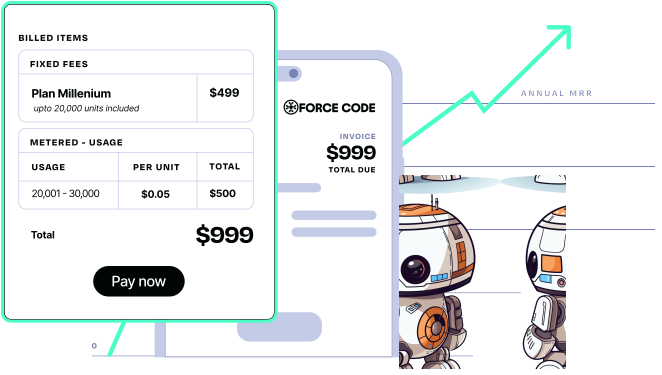
Togai is particularly adept at implementing hybrid pricing models that combine fixed and usage-based fees, which is crucial for IoT ecosystems with complex billing needs.
What features of Togai help manage billing and revenue for IoT services?
Togai's Billing and Revenue Management Features for IoT Services:
- Automated subscription billing to simplify business management and reduce manual errors.
- Customizable payment methods to cater to a variety of customer preferences.
- Auto-invoice sends bills automatically according to business schedules.
- Token payments enhance customer data security.
- Transaction consolidation for efficiency in billing processes.
- Scalable infrastructure that maintains performance during high-traffic periods.
- Auditing trails for each event to resolve billing disputes and ensure accurate metering.
- Ability to handle complex pricing models, including variable or tiered pricing.
- Integration with existing tech stacks, including CRMs and payment gateways.
- Granular usage and revenue analytics help refine pricing and monetization strategies.